In recent years, festivals have become a cornerstone of the music and tourism industries in many countries, including Spain. However, recent events in the UK, where over 60 festivals have been canceled throughout 2024—totaling nearly 200 since 2019—are raising new questions and concerns about the future of these music events in Spain.
Are Festivals in the UK Coming to an End?
The UK has been a fertile ground for live music and festivals for decades, but it has recently experienced a troubling decline.
Since 2019, nearly 200 festivals have vanished—approximately 25% of the total just in the last year. The Association of Independent Festivals (AIF) attributes this situation to several factors:
- Significant increase in operational costs
- Widespread economic uncertainty
- Sustainability crisis among concert promoters and venues
A key factor leading to this situation in the UK is the status of “venues,” which are the bars, clubs, and smaller concert halls that have historically been the heart and foundation of the music scene in the UK.
Venues are the heart of the music scene in the UK
These venues are not only crucial for emerging artists but also serve as a springboard to larger festivals. In fact, many of the artists who currently headline major festivals started performing in these small venues.
These venues are facing a parallel crisis, with numerous closures due to rising operational costs, increasing rents, and the diminishing purchasing power of audiences, which in turn reduces their ability to attract enough patrons to remain viable.
For instance, in 2023, the famous Moles in Bath closed after 45 years, where legends like Oasis, Radiohead, The Cure, Supergrass, and Ed Sheeran played some of their first songs before becoming the big artists we all know today.
The Importance of Grassroots Venues
Music Venue Trust (MVT) conducted an experiment with the lineup of the famous Glastonbury festival in 2024 to demonstrate the importance of grassroots venues.
MVT edited the Glastonbury 2024 lineup, removing all artists who started their careers in these small venues. The result was that almost all names disappeared, leaving only a few, such as Burna Boy, SEVENTEEN, and Camila Cabello.
This is because prominent figures in the music industry have claimed, “We don’t believe there will be issues developing the next Ed Sheeran, etc., without grassroots venues; headliners keep coming.“
In response, MVT’s CEO, Mark Davyd, criticized the notion that the closure of these venues would not affect the development of new artists, arguing that most of the artists on the Glastonbury lineup began in those places.
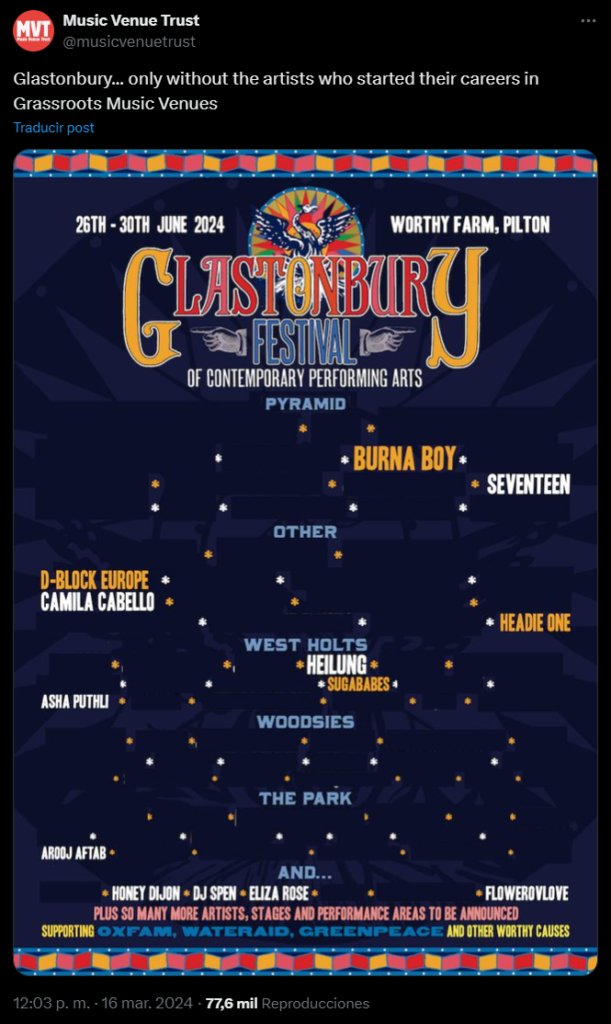
Thanks to the research and documentation from the MVT team, it was discovered that 91.7% of the artists announced for Glastonbury 2024 started in grassroots venues.
91.7% of the Artists Announced for Glastonbury 2024 Started in Grassroots Venues
It is estimated that the UK lost 10% of its grassroots venues in 2023, and the situation is described as “the worst in terms of venue closures.” MVT continues to advocate for greater investment from the industry and an entrance tax to support these crucial spaces for musical talent development.
How It Affects Festivals
The decline of these venues has a domino effect on festivals. Fewer places for live performances mean fewer opportunities for emerging artists to develop their careers and less diversity in festival programming.
The reduction of venues could lead to less diversity of artists at festivals.
Moreover, the lack of venues may diminish local live music culture, which directly impacts the demand for tickets to larger events. Thus, it is clear that this situation deeply affects the entire live music ecosystem in the UK.
And How Does This Situation Translate to Spain?
You might be interested: Growth, diversification and new challenges for the music industry in Spain
Are We Turning Festivals into a Luxury Good?
The current economic landscape in Spain presents similarities to that of the UK, raising the question of whether Spain could face a similar fate. Inflation, rising costs in energy, transportation, and other necessary expenses, along with increasing salary demands, are challenges that are already affecting the cultural and entertainment industries.
Taking it a step further, the crucial issue that could lead to a crisis like the one we’re discussing is the perception of festivals as a “luxury good.“
As organizing costs increase, ticket prices also rise, distancing a significant segment of the population. The largest festivals in Spain have experienced notable price increases in recent years, especially for VIP tickets and exclusive experiences that are now part of the standard package for many of these offerings.
Festivals Could Be Turning into a Luxury Good
This trend could make festivals inaccessible for many, reaching a point where attendance may not cover the event’s expenses.
The transformation of festivals into luxury goods could reduce ticket demand in an environment where economic uncertainty forces consumers to prioritize their spending. Recent data from the UK shows that only 44% of music fans planned to buy tickets for festivals in 2024, a concerning sign that this trend is already underway.
Thus, if Spain follows the same path, it is likely that decreasing demand will trigger a chain reaction, affecting the viability of many festivals, limiting their growth, and threatening their long-term sustainability.
A Warning for the Future of Festivals in Spain
It is difficult to predict with certainty whether Spain will experience a collapse in the festival sector similar to that of the UK; however, the situation in the UK serves as a clear warning of what the future of this industry might hold.
Festival organizers and promoters in Spain, considering this information, must remain proactive and adapt to changing market conditions and audience dynamics by developing financial sustainability strategies, pursuing greater collaboration with public and private entities, and, above all, remembering that live music has a cycle where every single step is important for the growth of this business.
You might be interested: Television formats and their impact on the music industry