Much has been said about Spotify’s recent data on the streaming economy in Spain through the Loud&Clear platform. For the first time, an in-depth exploration of the territory and its major milestones has been conducted, shedding light on what can be considered a reflection of the long race in which the national music industry is immersed.
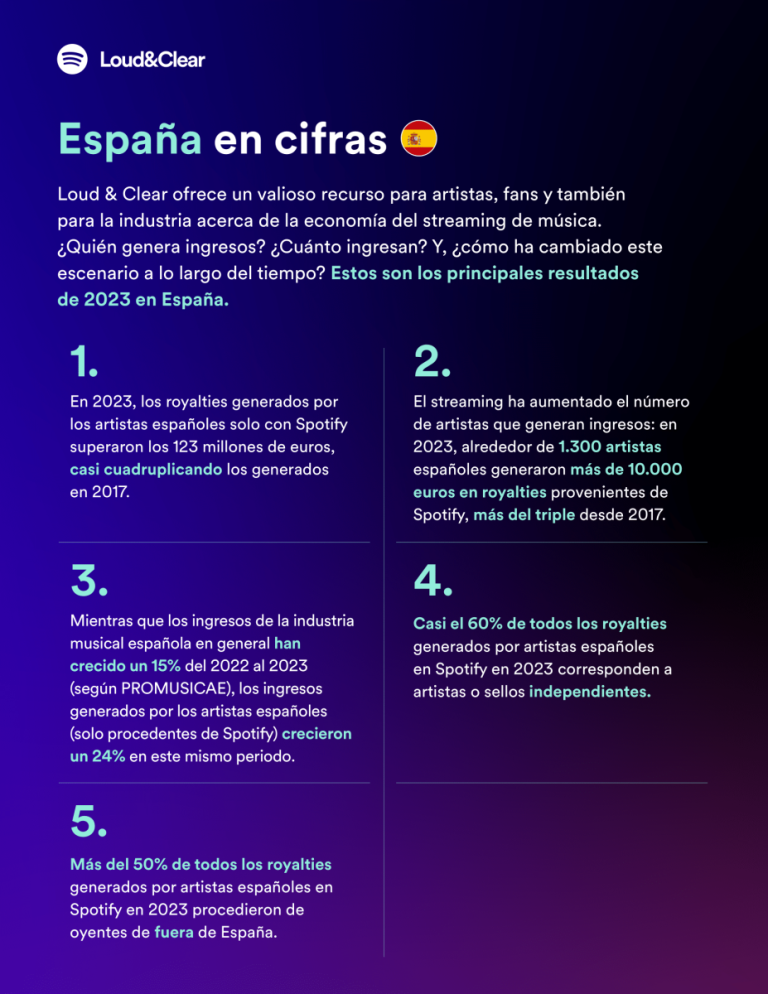
The first striking figure is the revenue generated by Spanish artists on Spotify, with over 123 million euros in royalties, an amount that has quadrupled in just seven years.
In 2023, around 1,300 Spanish artists generated more than €10,000 in royalties, an amount that has tripled compared to the data from 2017.
In the general industry, revenue has increased by 15% from 2022 to 2023 (data collected by PROMUSICAE). However, revenue specifically generated by Spanish artists grew by 24% over the same period.
Almost 60% of the royalties generated by Spanish artists on Spotify in 2023 came from independent artists or labels.
More than 50% of all royalties generated by Spanish artists on Spotify in 2023 came from listeners outside Spain.
Our music, therefore, can be said to be more diverse, with Spotify being a way to discover talent; and more international, capable of exporting the works of many Spanish artists to the rest of the world, not necessarily those with major multinational backing.
Much of this new healthy listener education is not only thanks to Spotify. Platforms like YouTube or TikTok have made music understand no borders or resources, only emotions and talent.
But within the framework of global music, what impact do these figures have? “It’s a good figure internally, but in reality, it’s still poor. Poor for several reasons,” analyzes Jorge Gálvez, co-CEO of Republic Network. “First, what is most shown is urban and pop music, what is trending and mainstream. Many genres are still not up to date digitally, such as flamenco, folk music… And second, we have a very rich territory that consumes music in its different formats: streaming, record purchases, concert tickets… To export, you have to get out of that bubble and practically start from scratch in new territories, there is a great effort and sacrifice in working to make the wheel turn on the other side of the ocean. We have iconic international references, such as Rosalía, C. Tangana, Nathy Peluso, Alejandro Sanz, Aitana, Bad Gyal, Pablo Alborán… but we have the capacity to develop and export much more.” And within the framework of Spanish music, our artists account for only between 2% and 6% of the impact.
If we delve into the analysis of the growth of Latin music, it has experienced healthy growth in the United States over the last few years. According to the RIAA’s end-of-year report on Latin music for 2022, total revenue increased from $881 million in 2021 to $1.1 billion in 2022. In 2023, that record high continued to rise, reaching $1.3 billion, a 17% increase over the previous year.
As Rafael Fernández Jr., Senior Vice President of State Public Policy and Industry Relations at RIAA, expresses: “In the past decade, Latin music has exploded in the United States thanks to a new generation of stars driving the genre and the accessibility offered by streaming, placing this dynamic sector within everyone’s reach. We are no longer limited by language, access, or outdated assumptions; Latin artists are shaping our culture while fans immerse themselves in the spirit of this music, driving faster growth than any other type of listening and expanding our horizons more each year. At the same time, there are opportunities for more fans to subscribe to paid streaming services and for Latin vinyl sales to soar even more, discovering different ways to connect and inspire unforgettable moments together, while artists and labels offer new sounds and songs.”
From Luis Fonsi to Peso Pluma, Duki, J Balvin, Manuel Turizo, Karol G, Bad Bunny, Bizarrap, Emilia, Camilo, Maluma, Ozuna, Feid, Young Miko, Rauw Alejandro, María Becerra, Shakira… The success of Latin music has established itself as another genre within the international scene, as journalist Pablo Gil points out in his article for El Mundo.
Antonio Guisasola, director of Promusicae, is blunt: “Spain used to be a country exporting music to Latin America and has become an importer: now it is Latin American artists who play here and perform more.”
The trend is for the consumption of Spanish music to continue to increase in the coming years. The challenge is, therefore, not only to consolidate and grow nationally but to be able to replicate and amplify the success of our artists beyond our borders. To do this, as an industry, we must bet on talent and help develop it.
Referencias:
- Loud&Clear, first report on national music consumption, Spotify Loud & Clear (byspotify.com)
- “The failure of Spanish artists in the mega-success of Latin music: ‘They have settled and have little capacity for effort’” by Pablo Gil for El Mundo
- PROMUSICAE, 2023 report El fracaso de los artistas españoles en el megaéxito de la música latina: “Se han acomodado y tienen poca capacidad de esfuerzo” | Música (elmundo.es)
- LUMINATE, Latin Music and Its Impact on Culture and Commerce in the U.S. Marketplace 2023 New Report: Latin Music and Its Impact on Culture and Commerce in the U.S. Marketplace | Luminate (luminatedata.com)
- RIAA 2023 year-end revenue statistics ESTADISTICAS-DE-INGRESOS-DE-RIAA-DE-FIN-DE-ANO-DE-2023.pdf
- Article “Spanish artists generated more than €123 million from Spotify in 2023” by Industria musical Artistas españoles generaron más de €123 millones de Spotify en 2023 – Industria Musical