In the 1970s, the United Kingdom faced one of its deepest crises. The economy was in decline, youth unemployment was reaching ever-higher levels, and society was stagnating in a classist and unequal system.
In the midst of this hostile environment, a countercultural movement emerged as a response to the situation, expressing the discontent and anger of a generation disillusioned with the system: Punk. Like we saw years later with K-Pop, Punk was not just about music; it became a movement, a form of rebellion against traditional institutions, with the British monarchy at the center of its critique.
This political and cultural confrontation, filled with symbolism, led to one of the most fascinating tensions in modern British history, leaving us with a musical genre that spread around the world.
Was Punk born in the UK?
Although Punk is often associated with the United Kingdom, this distinctive genre actually had its first influences on the streets of New York. In the early 1970s, bands like The Stooges and The New York Dolls were challenging musical and social rules with an aggressive and chaotic style.
This approach caught the attention of Malcolm McLaren, who, after briefly working as the manager of the New York Dolls, returned to London with the intention of creating his own band. Thus, the Sex Pistols were born, debuting in November 1975 at a small concert at St. Martin’s College of Art.
Bands like The Clash and Siouxsie and the Banshees also channeled youth frustration with the established system. As Joe Strummer, vocalist of The Clash, explained: “Punk wasn’t just about music; it was about having a voice when it felt like we had none. We wanted real change.” This statement summarizes the sentiment and message that was resonating with British youth at the time, thanks to this new genre.
"Punk wasn't just about music; it was about having a voice when it felt like we had none"
Joe Strummer, vocalist of The Clash
You might be interested in: Haute couture and urban fashion connected by music
"God Save the Queen"
The British monarchy, one of the country’s oldest institutions, represented for many Punk followers an archaic system based on birthright privilege, disconnected from the people’s needs. In a context of economic crisis, inflation, and strikes, the monarchy offered a sense of continuity for some, but for the punks, it symbolized the perpetuation of inequality.
It is not surprising, given this, that the most forceful cultural attack on the monarchy came from the Sex Pistols in the form of a song: “God Save the Queen.”
Far from being a tribute, the song mocked the national anthem and sent an incendiary message by declaring that the Queen was nothing more than a “fascist figure” in a “no future” country, suggesting that the constant focus on the monarchy was merely a mechanism to divert attention from the country’s real problems.
This provocation was met with fury by the more conservative sectors of British society, and the single was banned from being played on the BBC, reaching the point where record stores refused to sell it.
Still, it’s very difficult to extinguish a fire once the flame has been lit. The song had become much more than just a single; it was an anthem of rebellion and rejection of the Crown for young people disillusioned with the situation in the United Kingdom, reaching the top of the charts.
"God Save the Queen" became an anthem for the young Punks of the United Kingdom.
Johnny Rotten (John Lydon), the lead singer of the Sex Pistols, stated that “we never set out to destroy the Queen personally, but rather what she represented: a rotten and obsolete system that needed to be challenged.”
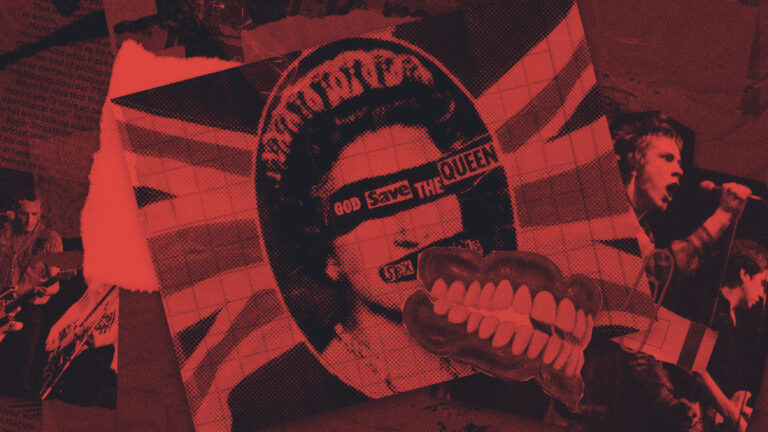
Much of the visual art within Punk, especially those associated with the Sex Pistols, featured the figure of the Queen. The visual art for the album, designed by Jamie Reid, depicted the Queen with her eyes and mouth covered, symbolizing censorship and ridiculing the traditional sanctity of the monarchy.
This type of iconography, combined with the rebellious language of Punk music, broke with the traditional notion of the monarchy as a sacred symbol, portraying the Queen not as a deified figure but as another human being, and therefore, subject to criticism and contempt.
Historian Paul Gilroy argued that Punk was one of the first modern subcultures to “demoralize the monarchy.” By questioning its relevance and sanctity, Punk allowed future generations of Britons to view the monarchy in a more critical and less reverent way.
In this sense, Punk was not just a rebellion against political institutions, but also against one of the deepest cultural symbols of British society.
You might be interested in: Latin music recognition under debate after the Grammys 2024 Gala
Punk as a social, cultural, and political movement
The clash between Punk and the British monarchy was, in essence, a clash of symbols. The monarchy represented stability, tradition, and continuity in a society that seemed to be crumbling under the weight of its economic and social problems. Queen Elizabeth II, as the central figure of the monarchy, embodied these values.
On the other hand, Punk personified disruption, chaos, and resistance against these same traditions. For the punks, the monarchy was not only irrelevant but part of the problem—a pillar of privilege in a world that needed radical change to achieve a fairer society. In that sense, Punk criticized the monarchy not only in political terms but also in cultural terms, demystifying its aura of sanctity and ridiculing the cult surrounding it.
Beyond being a musical genre, Punk became a subculture that impacted fashion, art, and politics. As designer Vivienne Westwood, who was deeply associated with the movement, expressed: “Punk was a revolution. It wasn’t just about music or fashion; it was about changing the way we thought about the world. It was a rejection of conformity.”
A lasting impact
The legacy of Punk continues to this day. The relationship between British popular culture and the monarchy has changed drastically since the 1970s, largely thanks to this movement and musical genre.
While in earlier times the monarchy was treated with solemnity, today it is frequently the subject of parody and criticism. Series like “The Crown” and films like “The Queen” have humanized the royal family, showing not only their moments of greatness but also their most real facets and moments.
It is interesting to note that, although Punk managed to question and destabilize the image of the monarchy, the institution has shown a remarkable capacity for adaptation. This demonstrates the complexity of the symbolism of the monarchy that the Punk community faced: although it has been attacked and ridiculed, it remains an important pillar for many British, adapting and reinventing itself to stay relevant in an ever-evolving society.
The transformative power of music
Throughout history, music has proven to be a powerful driver of change, challenging the system, exposing injustices, and giving voice to the most marginalized sectors of society.
In the case of British punk, music became a tool to express the rage and frustration of a generation in the face of power structures and traditional institutions.
For punks, music specifically and art in general, became a valuable tool against power
Punk awakened millions of young people to a new critical consciousness, teaching them that they could question not only the political class but also the most revered symbols of society.
The impact of Punk was not limited to music; its spirit of resistance inspired activists, artists, and writers to adopt the “Do It Yourself” ethos and fight for their beliefs. This legacy reminds us that, in times of crisis, music becomes a vehicle of resistance, a unifier of communities, and a driver of change.
You might be interested in: Why the Spanish Music Academy is important